Toy Rotation

Child Development
Children aren't losing attention spans — they're responding to overstimulating environments. Play researchers have a clear picture of what builds sustained focus in young children. It's not what most parents are doing.
Cartwheel · 5 min read · Child Development · Play Science
A version of this worry appears in almost every parenting conversation about young children: kids today can't focus. Their attention spans are shorter than ever. Screens are to blame, or toys are too stimulating, or something about modern childhood has fundamentally changed children's capacity to stay with one thing.
The research on this is more nuanced — and, in many ways, more useful — than the popular narrative suggests. Children's attention capacity has not meaningfully declined. What has changed is the environment in which children are expected to pay attention. And that environment is something parents can actually do something about.
Developmental researchers distinguish between several different kinds of attention, and they do not all follow the same trajectory or respond to the same environmental inputs.
Selective attention
The ability to focus on one thing while ignoring competing stimuli. This is the attention type most affected by environmental noise and toy quantity. A child with ten toys visible is being asked to exercise selective attention constantly, just to pick one thing to play with.
Sustained attention
The ability to maintain focus on a single activity over time. This is what parents usually mean when they say their child "can't focus." Sustained attention in young children is strongly correlated with environmental structure — specifically, with the number of competing options available at any moment.
Executive attention
The ability to deliberately direct and manage one's own focus. This develops slowly through middle childhood and is the foundational skill for school readiness. It is built through repeated practice of sustained attention in low-distraction environments — not through exposure to more stimulating or varied material.
When a parent says their child can't focus, they are usually observing a sustained attention deficit. The research is clear that sustained attention in young children is environmentally mediated — it is a product of the child's surroundings as much as their neurology.
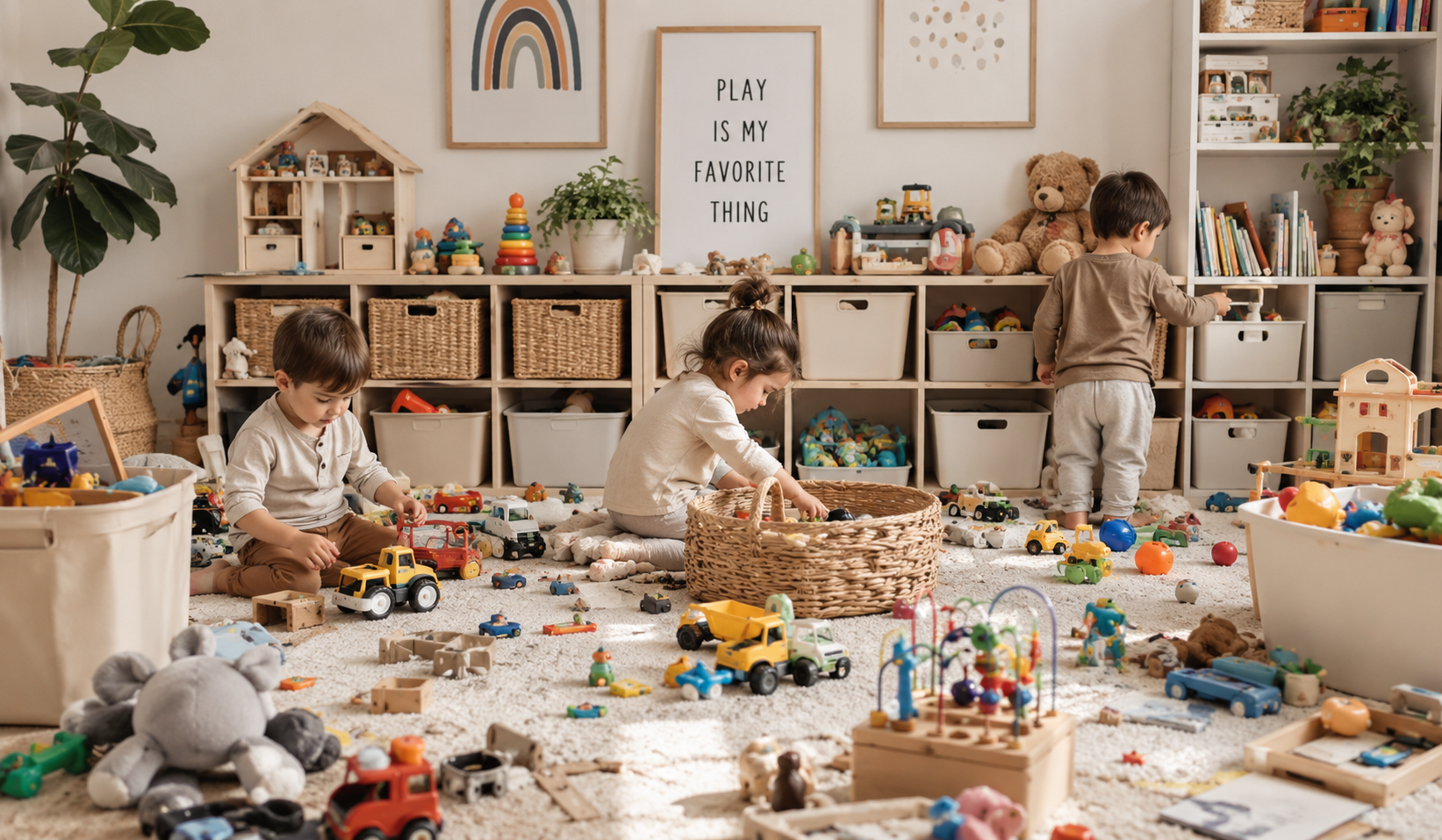
In 2018, researchers at the University of Toledo conducted what became one of the most cited studies in recent child development literature on this topic. Toddlers placed in rooms with fewer toys demonstrated significantly longer sustained attention than children in rooms with more toys — not because they were inherently more focused, but because the environment wasn't constantly pulling their attention elsewhere.
The child who can't stay with one toy for more than two minutes in a full playroom may stay with the same toy for twenty minutes when it's one of four available options.
Same child. Different environment. Different outcome.
This is the environment hypothesis: that what looks like an attention problem is, in many cases, a rational response to an overstimulating environment. A young child surrounded by twenty toys is not failing to pay attention — they are paying attention to all twenty of them simultaneously, which makes deep engagement with any one impossible.
Why this matters for how we interpret children's behavior
The environment hypothesis has significant practical implications. If short attention spans are primarily a function of the child — their neurology, their generation, their exposure to screens — then parents have limited options. If they are primarily a function of the environment, parents have considerable power to change them.
The evidence points strongly toward the environment. Studies comparing children in Montessori environments (limited toys, orderly presentation, minimal competing stimuli) with children in conventional early childhood settings consistently show longer sustained attention in Montessori children — even when controlling for the children's baseline attention capacities and family backgrounds.
The research points to a consistent set of environmental and experiential factors that support the development of sustained attention in children zero to six.
Undermines attention
Builds attention
The role of mastery in sustained play
One of the most consistent findings in play research is that children sustain attention longest on activities where they experience a sense of emerging mastery — where the challenge is just slightly above their current ability, and where their engagement produces visible results they can track.
This is why a child who has been playing with the same set of blocks for two weeks will build more complex structures in week three than in week one. They are not bored — they are developing. Their sustained engagement is a signal that mastery is underway. Introducing a new toy at this point, however well-intentioned, interrupts the mastery cycle.
It is also why toys with only one mode of use — press the button, hear the sound — tend to produce short attention periods. There is no emerging mastery to sustain. The child learns everything the toy can do in five minutes and moves on. Open-ended toys — blocks, dolls, art materials, simple vehicles — support sustained attention precisely because mastery of them is never complete.
Key insight from play research
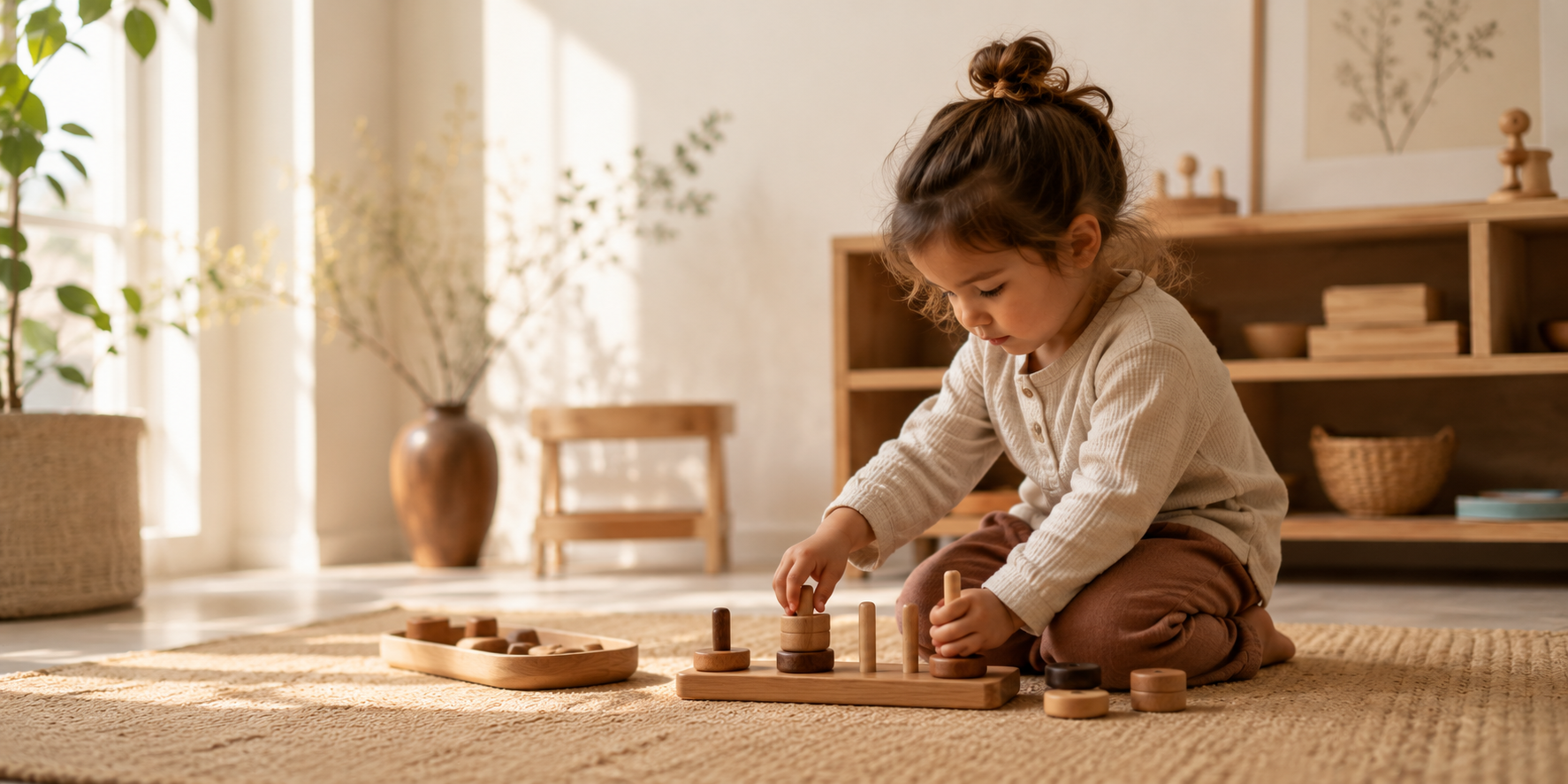
Open-ended toys produce longer attention spans than single-function toys — not because they are more stimulating, but because they offer a continuous challenge. A child cannot fully master a set of blocks. They can always build something taller, more complex, more intentional. That unresolved challenge is what keeps them coming back.
Any honest discussion of children's attention has to address screens, which are frequently cited as the primary cause of shortened attention spans in children. The research here is more mixed than the popular narrative suggests.
High-quality, slow-paced, age-appropriate screen content (think Bluey, not YouTube's autoplay queue) does not appear to meaningfully harm sustained attention capacity in young children. Fast-paced content with rapid scene changes, constant novelty, and immediate reward cycles is a different matter — and the concern there is legitimate.
But screens, in most families, are a symptom rather than the root cause. Children turn to screens when their physical environment does not offer the conditions for sustained play: when there are too many options and none of them feel compelling, when the play space is cluttered and hard to settle into, when boredom arrives and there is no structure to push through it. The families who report the least screen dependency tend to be the ones who have invested most in the physical play environment. Not by buying more, but by curating what's available.
If sustained attention in young children is primarily environmentally mediated, then the intervention is environmental. Specifically:
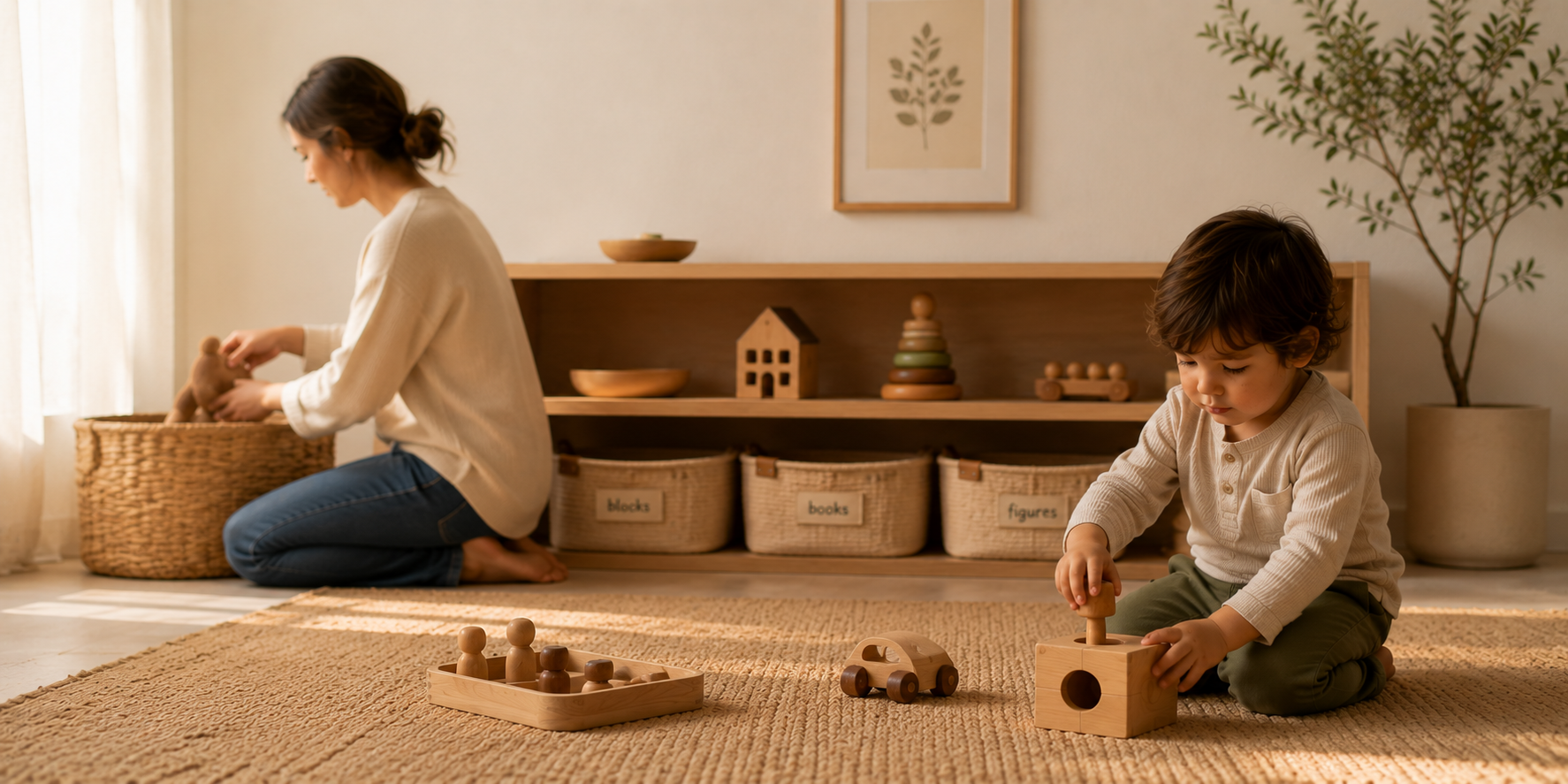
Reduce what's visible. Four to six toys out, everything else stored. The research on this is consistent and strong.
Prioritize open-ended materials. Blocks, construction toys, dolls and figures, art supplies, simple vehicles. These are the toys that produce the mastery cycles that sustain attention.
Protect uninterrupted play time. Sustained attention requires time to develop within a single session. Short, interrupted play periods teach children to skim rather than dive. A 45-minute free play period produces more developmental value than three 15-minute windows.
Let boredom arrive. The moment before a child finds their way into deep play often looks like restlessness. Parents who intervene at this point — offering a new toy, redirecting to an activity — short-circuit the process. The restlessness is the precondition. Let it work.
Rotate, don't accumulate. The goal is a curated available set that stays fresh through rotation rather than through constant purchase. A toy that has been stored for four weeks is, experientially, nearly new again.
Attention is not a trait. It's a skill. And like all skills, it develops through practice — specifically, through repeated experience of settling into, and sustaining, deep engagement with one thing at a time.
The environment either supports that practice or undermines it. Most toy-buying decisions undermine it.
Cartwheel is a toy rotation app for families with children zero to six. The core system is simple: families log their existing toy library, choose a small rotation to keep accessible, and store the rest. The app tracks what's in rotation, reminds families when to swap, and suggests what to bring out based on developmental stage and what their child has been playing with.
The rotation creates the environmental conditions that the research consistently associates with longer attention, deeper play, and more creative engagement — without requiring new purchases, significant time investment, or a complete rethinking of how the family approaches toys.
It also connects families locally, so that as children develop and rotate through developmental stages, they can share toys with neighbors rather than buy new ones. The effect is access to a broad library of developmentally appropriate materials, curated thoughtfully, without the clutter that undermines the environment it's meant to support.